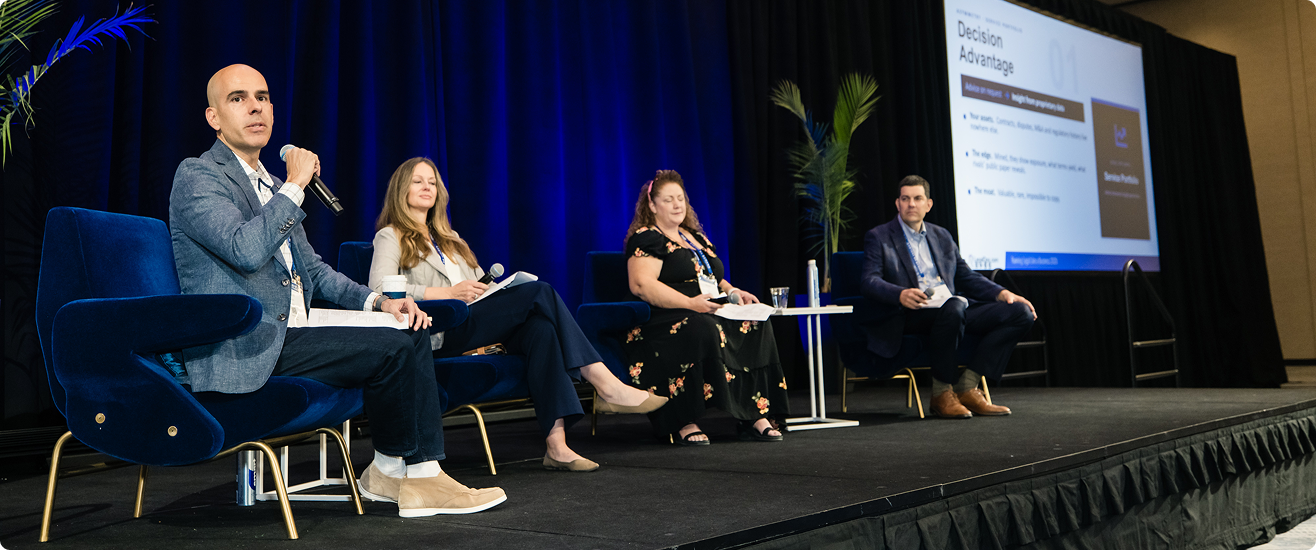
When Relationships Pick the Law Firm, AI Is Giving the Data a Vote


Long-standing relationships have always carried weight when in-house lawyers choose outside counsel, but AI is giving legal operations teams a stronger hand in asking an uncomfortable question: Does the data support sending the work there?
That shift can have a sizable payoff, panelists at the Running Legal Like a Business Conference in Las Vegas, said. Carol Bouw, head of global legal operations at Cargill, described using outside counsel data at a previous company to identify routine, lower-risk work that was going to more expensive [rms largely because that was where lawyers had always sent it.
By gradually moving some of that work to smaller [rms already being used by the department, her team cut about $80,000 a year from real estate legal spend. Repeating the exercise elsewhere produced more than $500,000 in savings.
“Pretty easily, just by making some small tweaks, we found over half a million dollars just by doing things like that with the data,”
The discussion came during the conference session “Stop Managing in Pieces: Architecting an AI-Driven Outside Counsel Program” on Thursday.
Bouw was joined by Daniel Decker, a technical product management associate at Wolters Kluwer; Jennifer McIver, a director with Wolters Kluwer ELM Solutions; and Arun Mistry, former director of legal operations at Starbucks.
The panel focused on combining measures such as billing compliance, budget performance, staffing leverage, timekeeper continuity and market-rate information rather than judging law firms on isolated metrics.
For years, legal departments have had much of that information. The problem has been connecting it and putting it into context, Mistry explained.
“It's not just about having the data; it's about contextualization,”
AI could make that easier by analyzing billing narratives, stabng patterns and cost performance across large numbers of matters. Decker said that creates an opportunity for objective information to carry more weight alongside the personal relationships that frequently drive outside counsel decisions.
“We are at an injection point,” he said. “We now have this tool that allows us not necessarily to trump the relationship, but to kind of compete with that relationship.”
That doesn't mean the lowest-cost firm automatically wins, they noted. Decker said outcomes still matter more than any individual metric, while panelists repeatedly emphasized that expertise, matter complexity and business context can justify apparent outliers.
But objective data can force a conversation that might not otherwise happen. If a firm repeatedly blows through budgets, uses partners for work that could be handled by associates, or staffs matters the same way regardless of complexity, legal departments can increasingly see those patterns across their portfolios rather than discovering them one invoice at a time.
Bouw said the transparency itself can change behavior. “What becomes measured gets fixed,” she said. “If they don't know the ratio of associate versus partner work happening within their organization, they can't do anything about it.”
The same information can also reshape conversations with [rms. Instead of simply demanding lower rates, clients can ask a [rm to build a deeper associate bench, explain staffing choices or move lower-risk work to less expensive lawyers.
Mistry said law firms themselves already possess substantial information about what work should cost, making it harder to argue that certain matters are simply too unpredictable to price.
“Your marketing material tells me that you've done this 1,000 times, so you already have all of this data telling you how much it should cost,” he said.
Still, panelists cautioned against turning outside counsel selection entirely over to an AI agent. The technology can surface patterns and put relevant information in front of lawyers, but judgment and communication remain essential.
Mistry expects the balance between relationships and data to shift further as a younger generation of legal leaders takes over relationships that were sometimes forged decades ago between general counsel and law firm partners.